

Albert Park
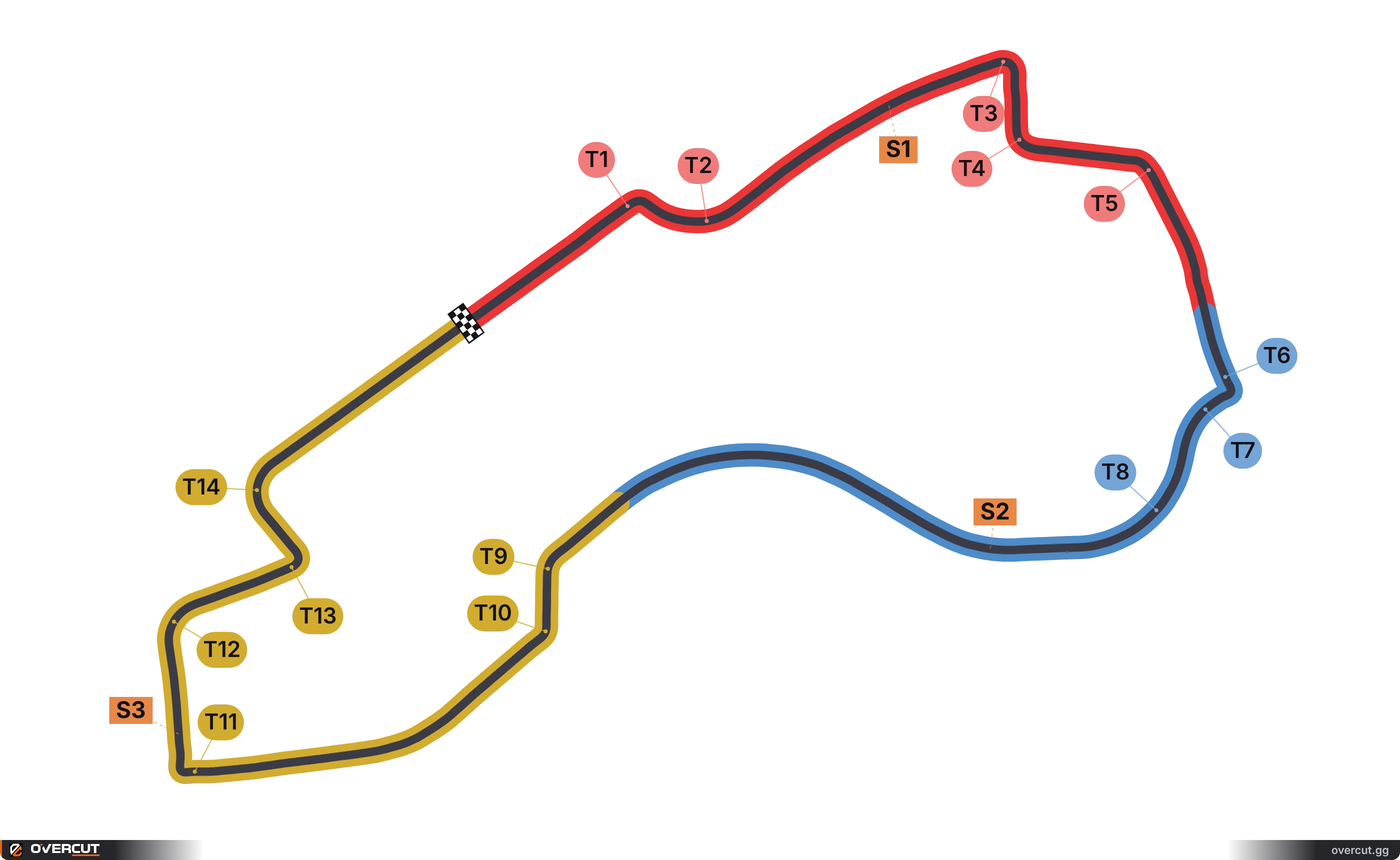
Melbourne, Victoria, Australia · 5.278 km · 14 corners
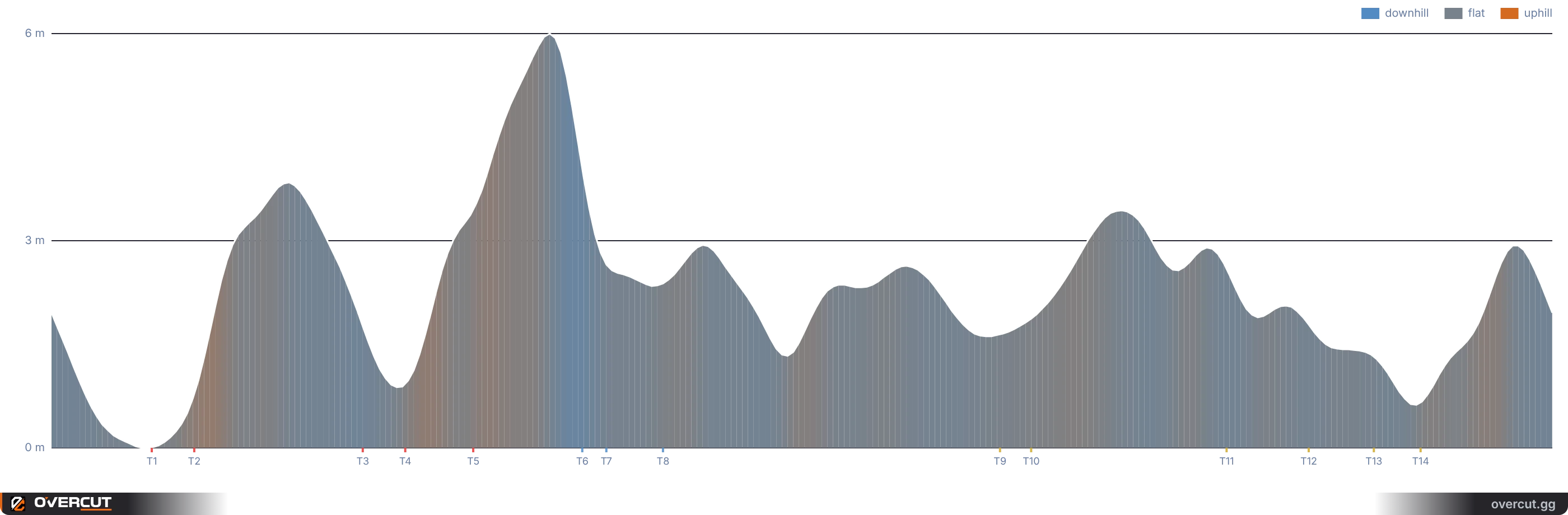
Elevation profile
Albert Park runs 5.278 km over 14 corners, 5 left and 9 right, driven clockwise.
The layout Overcut measured is 5.304 km, and every distance quoted here for corners, sectors and straights is taken on it.
It rises and falls 6.4 m, 0.3x the relief of Monza. The steepest climb reaches 2.0% and the steepest drop 2.7%.
The longest straight is 985 m, between T8 and T9.
The longest corner is T8, 245 m of tarmac from entry to exit.
The sector lines fall at 1,762 m and 3,182 m, not at thirds of the lap.
The story
Albert Park is a street circuit laid out on the park roads around a lake in Melbourne. It hosted the Australian Grand Prix in 1953 and 1956, Formula 1 has raced there since 1996, and the layout was reworked for 2022 with two fewer corners. On the current layout the lap is 5.278 km, according to the FIA.
- 1953
The first Australian Grand Prix around the lake
On 21 November 1953 Albert Park hosts its first Australian Grand Prix, the first race around the lake, as the Australian magazine Auto Action puts it. Doug Whiteford wins in a Talbot-Lago T26C by six laps. The same magazine counts it as his third and last win in the race, after 1950 and 1952.
- 1956
Moss wins for Maserati in Melbourne's Olympic year
Goodwood says Albert Park hosted the Australian Grand Prix twice in the 1950s, on a layout similar to today's but run anti-clockwise. The second time, in 1956, the race was part of the celebrations for Melbourne's Olympic Games, and Stirling Moss won it in a Maserati 250F. The world championship would only come to the park in 1996.
- 1996
Four months after Adelaide, Formula 1 moves to Melbourne
Formula1.com says the deal to bring Formula 1 to Melbourne was done in 1993, with a circuit made from the existing roads of Albert Park. The first race, on 10 March 1996, comes four months after Adelaide's last Australian Grand Prix. Jacques Villeneuve starts from pole and Damon Hill wins, ahead of Villeneuve in a Williams one-two. Formula1.com says the race is best remembered for Martin Brundle's crash at Turn 3 of the layout of the time, when his Jordan launched off the back of Johnny Herbert's Sauber.
- 2020-21
Cancelled hours before practice, and again the next year
On 13 March 2020 Formula 1, the FIA and the Australian Grand Prix Corporation cancel the season-opening race, after a McLaren team member tested positive for the coronavirus and the team withdrew. Motor Sport Magazine says the cancellation came two hours before the first practice session. The 2021 race, moved to November, is cancelled on 6 July 2021, the second year in a row.
- 2022
Formula 1 returns after two years, with two fewer corners
Formula 1 returns on 10 April 2022 to a reworked track. The Checkered Flag lists the changes: the chicane at the old Turns 9 and 10 is removed, Turn 1 is widened by 2.5 m, Turn 3 by 4 m and Turn 6 by 7.5 m, and with two fewer turns the old Turns 13 and 15 become Turns 11 and 13. Formula1.com gave the 2019 layout as 5.303 km; the FIA map for the 2026 race gives 5.278 km. Charles Leclerc wins for Ferrari. In December 2022 the Victorian government extends the race at Albert Park to 2037, Motorsport Week reported.
- 2026
A Mercedes one-two opens the 2026 season
On 8 March 2026 Albert Park opens the season. Oscar Piastri, the home driver, crashes his McLaren on the way to the grid and does not start, the FIA reports. George Russell wins ahead of Kimi Antonelli in a Mercedes one-two, with Charles Leclerc third, in a race the FIA presents as the start of Formula 1's new era of energy recovery and deployment. On the 2027 calendar announced in September 2026, Melbourne is the third round, on 2 to 4 April.
How the layout changed
- 20195,303 m
The layout before the changes for 2022, according to Formula1.com's page for the 2019 race.
- Today5,278 m
The current layout, two corners shorter, according to the FIA circuit map for the 2026 race.
Sources: FIA, 2026 Australian Grand Prix circuit map · Formula1.com, Australian Grand Prix 2026 circuit · Formula1.com, Australian Grand Prix 2019 circuit · Auto Action, Australian Grand Prix at Albert Park: 70 years young (2023) · Goodwood, the history of the Australian Grand Prix · Formula1.com, 1996 Australian Grand Prix result · Formula1.com, 1996 Australian Grand Prix starting grid · Formula1.com, cancellation of the 2020 Australian Grand Prix · Motor Sport Magazine, 2020 Australian Grand Prix cancelled · Motor Sport Magazine, 2021 Australian Grand Prix cancelled · The Checkered Flag, track changes at Albert Park (February 2022) · Australian Grand Prix official programme, track guide · Formula1.com, 2022 Australian Grand Prix result · Motorsport Week, Australian GP extended through 2037 (December 2022) · FIA, Russell wins season-opening 2026 Australian Grand Prix · Formula1.com, 2026 Australian Grand Prix result · McLaren, 2027 Formula 1 calendar announced (September 2026)
Corner by corner
Entry, apex and exit are measured on the 5.304 km layout.| Corner | Direction | Entry | Apex | Exit | Sector |
|---|---|---|---|---|---|
| T1 | right | 329 m | 354 m | 409 m | S1 |
| T2 | left | 419 m | 504 m | 569 m | S1 |
| T3 | right | 1,059 m | 1,099 m | 1,159 m | S1 |
| T4 | left | 1,204 m | 1,249 m | 1,304 m | S1 |
| T5 | right | 1,429 m | 1,489 m | 1,519 m | S1 |
| T6 | right | 1,864 m | 1,874 m | 1,939 m | S2 |
| T7 | left | 1,949 m | 1,959 m | 2,039 m | S2 |
| T8 | right | 2,069 m | 2,159 m | 2,314 m | S2 |
| T9 | left | 3,299 m | 3,349 m | 3,384 m | S3 |
| T10 | right | 3,442 m | 3,459 m | 3,479 m | S3 |
| T11 | right | 4,124 m | 4,149 m | 4,214 m | S3 |
| T12 | right | 4,379 m | 4,439 m | 4,504 m | S3 |
| T13 | left | 4,639 m | 4,669 m | 4,734 m | S3 |
| T14 | right | 4,769 m | 4,834 m | 4,909 m | S3 |
Which simulators ship this circuit

More race tracks
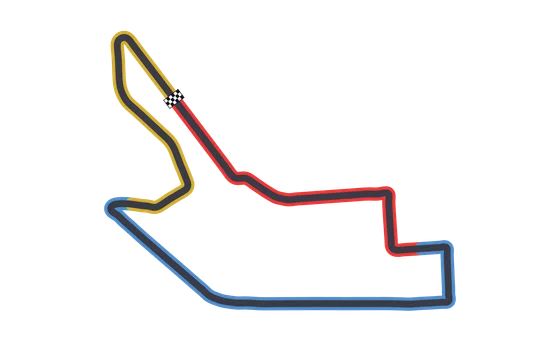 AdelaideAdelaide, South Australia, Australia3.219 km · 14 corners · 15.2 m of relief
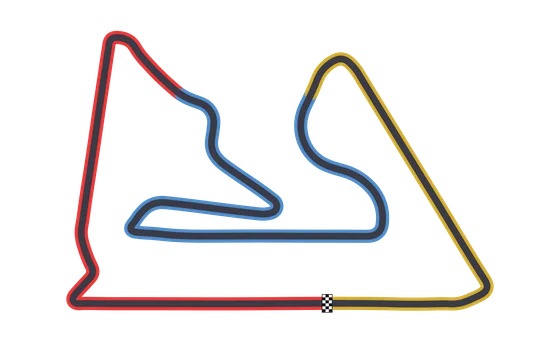 BahrainSakhir, Southern Governorate, Bahrain5.412 km · 15 corners · 15.9 m of relief
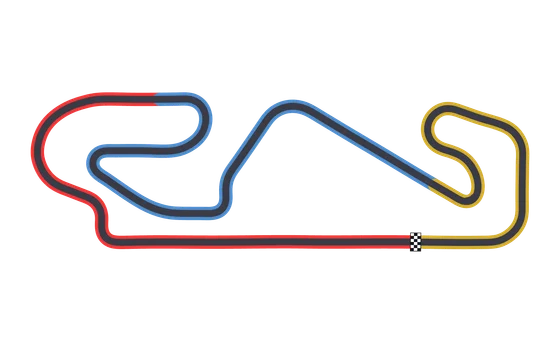 BarcelonaMontmeló, Catalonia, Spain4.657 km · 14 corners · 28 m of relief
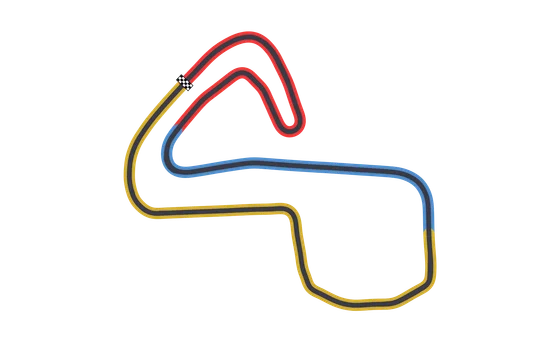 Brands HatchSevenoaks, England, United Kingdom3.916 km · 11 corners · 34.8 m of relief
Race Albert Park with Overcut open on a tablet: your live telemetry on any screen. See how Overcut works →