

Indianapolis
Speedway, Indiana, United States · 4.155 km measured · 15 corners
Official site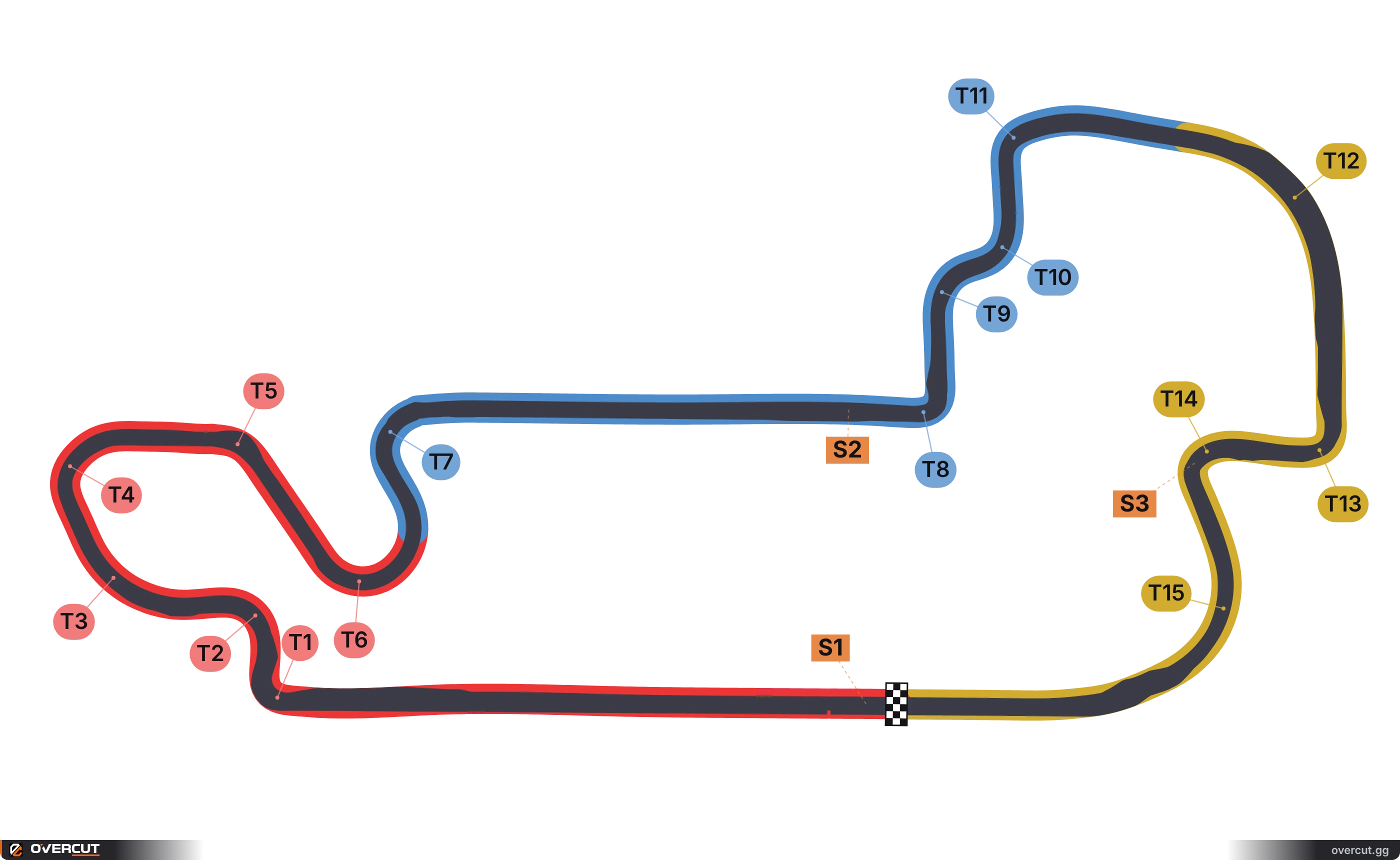
Elevation profile
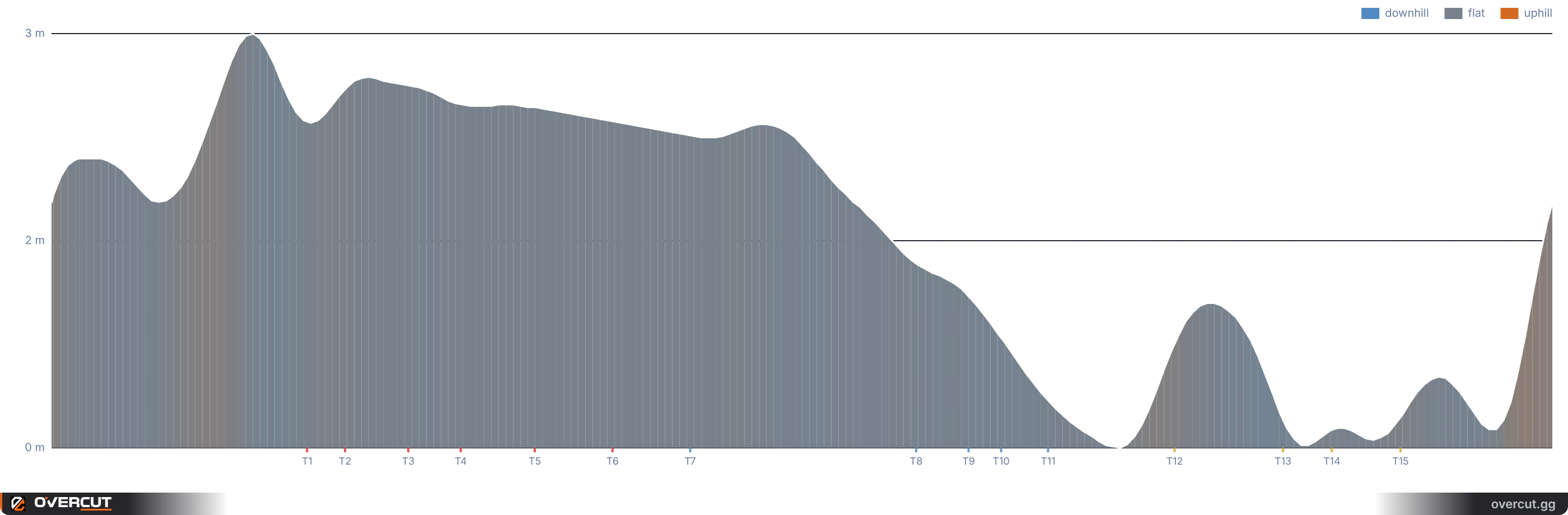
Indianapolis runs 4.155 km as measured on the layout over 15 corners, 5 left and 10 right, driven clockwise.
It rises and falls 3.1 m, 0.2x the relief of Monza. The steepest climb reaches 1.5% and the steepest drop 0.7%.
The longest straight is 880 m, between T15 and T1.
The track is 9.2 to 31.1 m wide, and its longest corner is T15, 290 m of tarmac from entry to exit.
The sector lines fall at 1,648 m and 2,962 m, not at thirds of the lap.
The story
Indianapolis Motor Speedway was built in 1909 and paved with bricks that same year, and in 2000 a new infield road course brought it Formula 1. After F1 (2000 to 2007) came MotoGP (2008 to 2015) and, since 2014, the INDYCAR Grand Prix. The Intercontinental GT Challenge finale, the Indianapolis 8 Hour, was held there in October 2026.
- 1909
A 2.5-mile oval opens in 1909 and is paved with bricks
The speedway is built in the spring of 1909 by Carl G. Fisher and three partners, as a testing ground for the local car industry. In the fall of 1909 the 2.5-mile oval is repaved with 3.2 million bricks, which gives it the name The Brickyard, according to the speedway.
- 2000
Formula 1 returns to the US on a new infield road course
The inaugural United States Grand Prix at Indianapolis is held in 2000, after a construction project announced in 1998. F1 races on a 13-turn, 2.605-mile road course run clockwise, the opposite direction of the oval. Michael Schumacher wins five of his seven starts there between 2000 and 2006, and Lewis Hamilton wins as a rookie in 2007. After the 2007 race the speedway and Formula One Management agree not to schedule F1 at Indianapolis in 2008, according to the speedway.
- 2005
Only six cars race the 2005 US Grand Prix
In 2005 the cars on Michelin tires withdraw after the formation lap, because of problems with the tires, and only the six cars on Bridgestone tires race, according to the speedway.
- 2008
MotoGP races at Indianapolis from 2008 to 2015
The Red Bull Indianapolis Grand Prix uses what the speedway describes as a 16-turn, 2.591-mile road course run counter-clockwise. In 2014 Dorna names it the "Best Grand Prix" of the season, the first North American race to get that honour, and the race is not on the 2016 schedule, according to the speedway.
- 2014
The INDYCAR Grand Prix starts on the road course
The inaugural INDYCAR Grand Prix is held in 2014, the first time the series heads north on the front straight, according to the speedway. In May 2026 INDYCAR describes the race as 85 laps on a 14-turn, 2.439-mile road course.
- 2026
A GMG Porsche wins the 2026 Indianapolis 8 Hour
The Intercontinental GT Challenge finale is held on 8 to 10 October 2026, with the race on 10 October. Kyle Washington, Riccardo Pera and Ayhancan Güven win for GMG Racing, and the series says the 56-second margin is a record and that they are the first Pro-Am crew to win the race in its seven-year history. The win gives Porsche the manufacturers' title, and Maxime Martin becomes drivers' champion.
Sources: Intercontinental GT Challenge, Indianapolis 8 Hour provisional race results · Indianapolis Motor Speedway, about the track · Indianapolis Motor Speedway, Formula One history · Indianapolis Motor Speedway, MotoGP history · Indianapolis Motor Speedway, INDYCAR Grand Prix history · INDYCAR, 2026 Sonsio Grand Prix preview · Intercontinental GT Challenge, Indianapolis 8 Hour report · Intercontinental GT Challenge, Indianapolis 8 Hour event page
Corner by corner
Entry, apex and exit are measured on the 4.155 km layout.| Corner | Direction | Entry | Apex | Exit | Sector |
|---|---|---|---|---|---|
| T1 | right | 662 m | 707 m | 757 m | S1 |
| T2 | left | 767 m | 812 m | 872 m | S1 |
| T3 | right | 887 m | 987 m | 1,047 m | S1 |
| T4 | right | 1,062 m | 1,132 m | 1,222 m | S1 |
| T5 | right | 1,292 m | 1,337 m | 1,382 m | S1 |
| T6 | left | 1,482 m | 1,552 m | 1,692 m | S1 |
| T7 | right | 1,737 m | 1,767 m | 1,805 m | S2 |
| T8 | left | 2,352 m | 2,392 m | 2,452 m | S2 |
| T9 | right | 2,492 m | 2,537 m | 2,582 m | S2 |
| T10 | left | 2,587 m | 2,627 m | 2,677 m | S2 |
| T11 | right | 2,702 m | 2,757 m | 2,857 m | S2 |
| T12 | right | 3,070 m | 3,107 m | 3,157 m | S3 |
| T13 | right | 3,352 m | 3,407 m | 3,457 m | S3 |
| T14 | left | 3,482 m | 3,542 m | 3,607 m | S3 |
| T15 | right | 3,647 m | 3,732 m | 3,937 m | S3 |
Which simulators ship this circuit



More race tracks
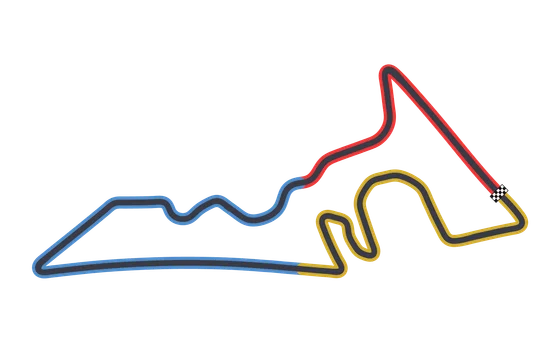 COTAAustin, Texas, United States5.513 km · 20 corners · 26.4 m of relief
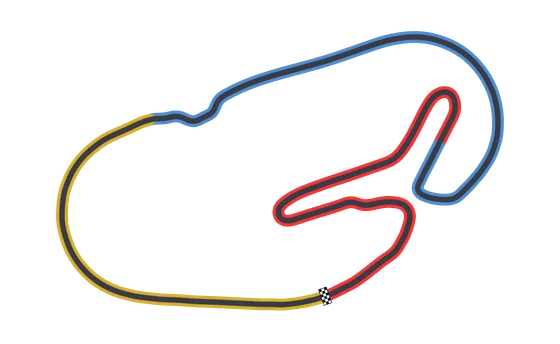 DaytonaDaytona Beach, Florida, United States5.752 km measured · 12 corners · 5.8 m of relief
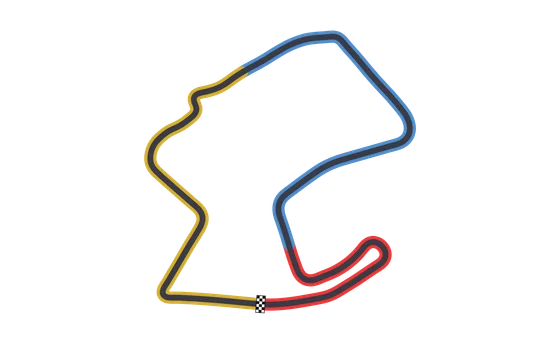 Laguna SecaMonterey, California, United States3.591 km measured · 12 corners · 53 m of relief
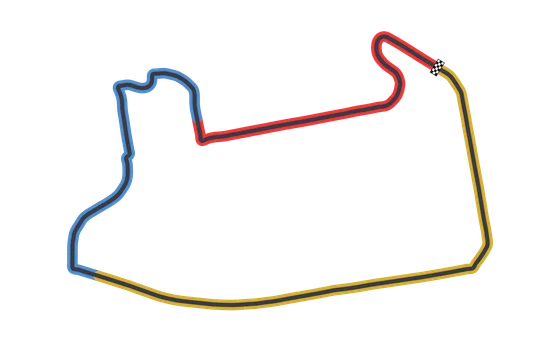 Las VegasClark County, Nevada, United States6.201 km · 15 corners · 20.5 m of relief
Race Indianapolis with Overcut open on a tablet: your live telemetry on any screen. See how Overcut works →