
Elevation profile
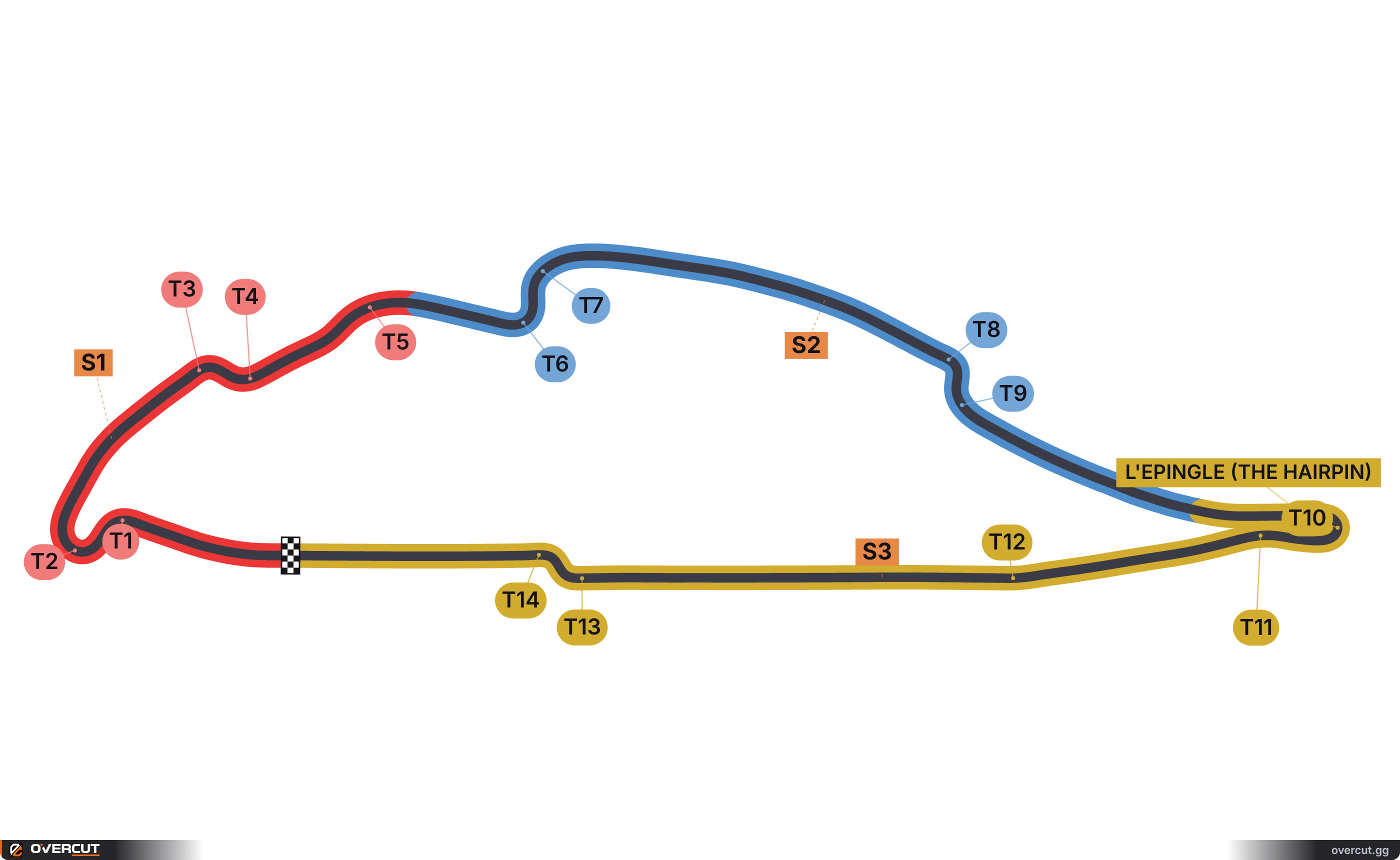
Montreal runs 4.361 km over 14 corners, 6 left and 8 right, driven clockwise.
The layout Overcut measured is 4.349 km, and every distance quoted here for corners, sectors and straights is taken on it.
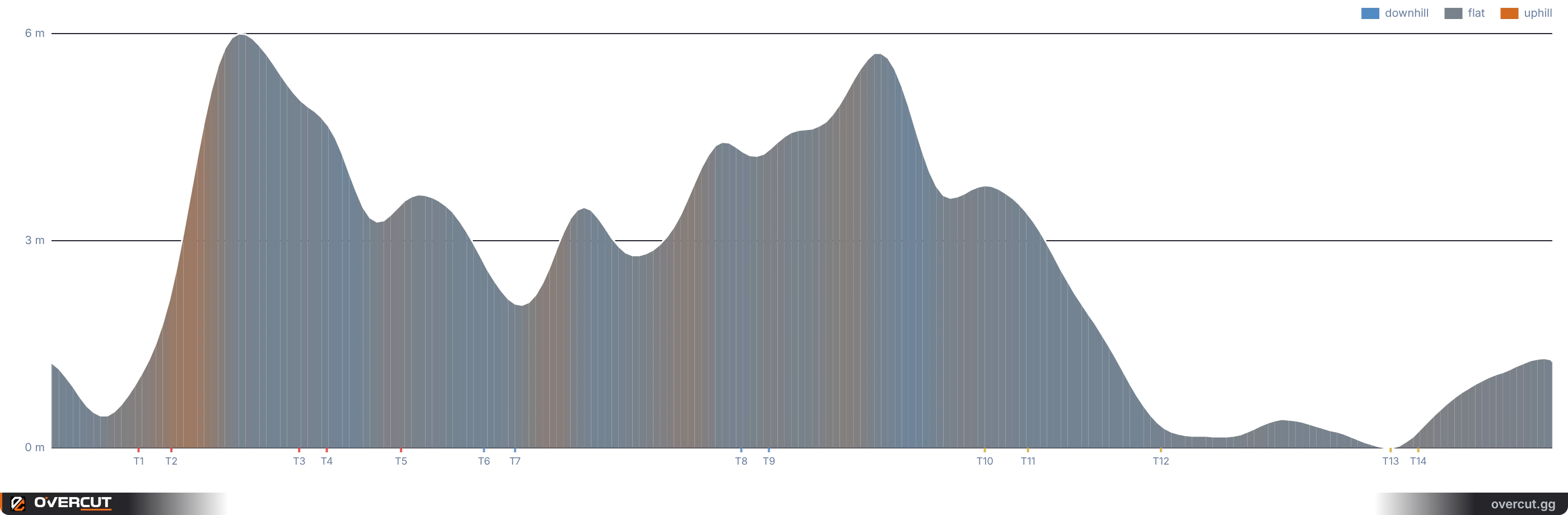
It rises and falls 5.9 m, 0.3x the relief of Monza. The steepest climb reaches 2.7% and the steepest drop 1.6%.
The longest straight is 615 m, between T12 and T13.
The longest corner is T2, 140 m of tarmac from entry to exit.
The sector lines fall at 1,089 m and 2,481 m, not at thirds of the lap.
The story
The Circuit Gilles Villeneuve loops around Île Notre-Dame, a man-made island in the St Lawrence River built with rock dug out for Montreal's Metro and opened for Expo 67. Formula 1 first raced there in 1978, when Gilles Villeneuve won, and since then the pits and the start line have moved, a corner has gone and the hairpin was pushed back; the layout used since 2002 measures 4.361 km. Since 2026 the race is held in May instead of June.
- 1978 and 1982
Villeneuve wins the first race, and the circuit takes his name
Designed by Canadian engineer Roger Peart on the island's existing roads, the circuit hosted its first Formula 1 race on 8 October 1978, taking over a Grand Prix that had alternated between Mosport Park and Mont-Tremblant. Gilles Villeneuve won it in a Ferrari, his first Grand Prix victory. He died on 8 May 1982 after crashing in qualifying for the Belgian Grand Prix at Zolder, and that same year the circuit, until then Circuit Île Notre-Dame, was renamed Circuit Gilles Villeneuve; Motor Sport's report of the June 1982 race already uses the new name.
- 1988 and 2019
Pits move to the chicane exit; new paddock opens in 2019
Formula 1 did not race in Montreal in 1987. In 1988 the pits and the start-finish line moved to their current place, at the exit of the fast right-left chicane, a change that also straightened a kink on the run to the new first corner, Motor Sport Magazine records. The paddock buildings put up in 1988 were replaced by new paddocks, inaugurated on 15 May 2019; promoter François Dumontier said the new garages more than doubled the space the teams had.
- 1994 and 1996
A chicane after the 1994 San Marino weekend, gone by 1996
In the aftermath of the tragic 1994 San Marino Grand Prix weekend, a temporary chicane was added between the Casino corner and the hairpin to reduce speeds. In 1996 that chicane was removed together with the Casino corner, creating the back straight that leads to the final chicane, according to Motor Sport Magazine.
- 1999
Three champions hit the same wall: the Wall of Champions is born
At the 1999 Canadian Grand Prix weekend, three world champions, Damon Hill, Michael Schumacher and Jacques Villeneuve, crashed into the concrete wall on the outside of the final chicane, as did Ralf Schumacher and Ricardo Zonta. Formula1.com says the corner's nickname, the Wall of Champions, comes from that weekend and has stuck to this day.
- 2002
Pit exit moved and hairpin pushed back: today's layout
In 2002 the pit lane exit was moved so that cars would no longer rejoin at high speed into Turn 1, and the Turn 10 hairpin was moved back to make room for run-off, which shortened the lap slightly, Motor Sport Magazine records. It was the last change to the layout, as PlanetF1 noted in 2024; the FIA's circuit map for the 2026 race gives its length as 4.361 km. Later work went into the surface and safety: before the 2024 race the FIA race director listed 13 changes, including a full resurfacing.
- 2024 to 2026
A deal to 2035, and the race moves from June to May
In November 2024 Formula 1 announced that, from 2026, the race would be held on the third or fourth weekend of May, so the European season could run as one block and one transatlantic crossing a year could be cut. In June 2025 a new four-year agreement kept Montreal on the calendar until 2035. On 24 May 2026, in the new slot, Kimi Antonelli won for the fourth race in a row after his Mercedes team mate George Russell, with whom he had been fighting, retired on lap 30 with a power unit issue; Lewis Hamilton was second.
Sources: Motor Sport Magazine, how Circuit Gilles Villeneuve was built in the middle of a river (June 2025) · Formula1.com, the Canadian Grand Prix: did you know? · Formula1.com, 5 reasons F1 fans are still in awe of Gilles Villeneuve (January 2021) · Motor Sport Magazine, 1982 Canadian Grand Prix race report (July 1982) · Société du parc Jean-Drapeau, paddock renovation project (December 2017) · Société du parc Jean-Drapeau via Newswire, inauguration of the new paddocks (May 2019) · GrandPrix247, François Dumontier on the new paddock (June 2019) · Formula1.com, what is the Wall of Champions (May 2026) · PlanetF1, the 13 track changes for the 2024 Canadian Grand Prix (June 2024) · Formula1.com, Canadian Grand Prix moves to May from 2026 (November 2024) · Formula1.com, F1 to race in Canada until 2035 (June 2025) · Formula1.com, 2026 Canadian Grand Prix race report · FIA, 2026 Canadian Grand Prix circuit map
Corner by corner
Entry, apex and exit are measured on the 4.349 km layout.| Corner | Name | Direction | Entry | Apex | Exit | Sector |
|---|---|---|---|---|---|---|
| T1 | no official name | left | 212 m | 252 m | 287 m | S1 |
| T2 | no official name | right | 297 m | 347 m | 437 m | S1 |
| T3 | no official name | right | 687 m | 717 m | 757 m | S1 |
| T4 | no official name | left | 762 m | 797 m | 832 m | S1 |
| T5 | no official name | right | 967 m | 1,012 m | 1,097 m | S1 |
| T6 | no official name | left | 1,202 m | 1,252 m | 1,297 m | S2 |
| T7 | no official name | right | 1,302 m | 1,342 m | 1,437 m | S2 |
| T8 | no official name | right | 1,972 m | 1,997 m | 2,037 m | S2 |
| T9 | no official name | left | 2,047 m | 2,077 m | 2,132 m | S2 |
| T10 | L'Epingle (The Hairpin) | right | 2,637 m | 2,702 m | 2,772 m | S3 |
| T11 | no official name | left | 2,812 m | 2,827 m | 2,842 m | S3 |
| T12 | no official name | right | 3,182 m | 3,212 m | 3,242 m | S3 |
| T13 | no official name | right | 3,857 m | 3,877 m | 3,917 m | S3 |
| T14 | no official name | left | 3,922 m | 3,957 m | 3,977 m | S3 |
Which simulators ship this circuit




More race tracks
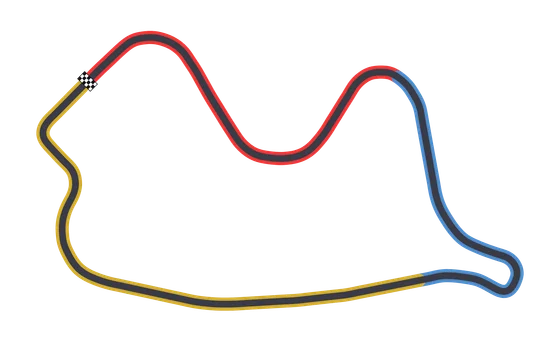 MosportBowmanville, Ontario, Canada3.957 km · 10 corners · 48.5 m of relief
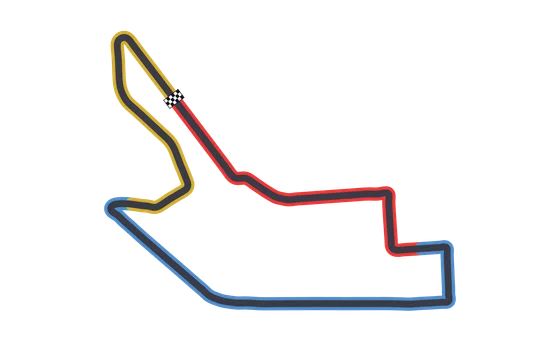 AdelaideAdelaide, South Australia, Australia3.219 km · 14 corners · 15.2 m of relief
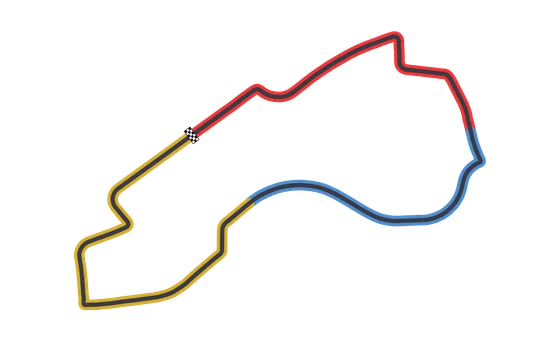 Albert ParkMelbourne, Victoria, Australia5.278 km · 14 corners · 6.4 m of relief
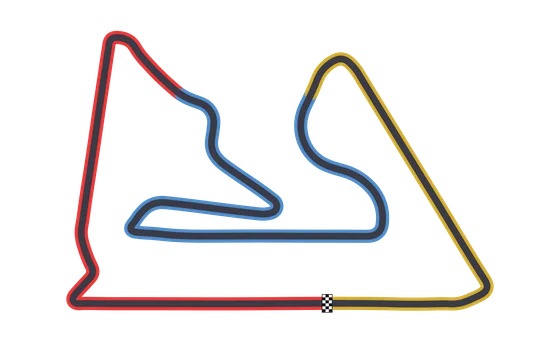 BahrainSakhir, Southern Governorate, Bahrain5.412 km · 15 corners · 15.9 m of relief
Race Montreal with Overcut open on a tablet: your live telemetry on any screen. See how Overcut works →