
Monza in 60 seconds
One lap of the circuit in 60 seconds, built from the same map, terrain and corner data as this page.
Watch on YouTube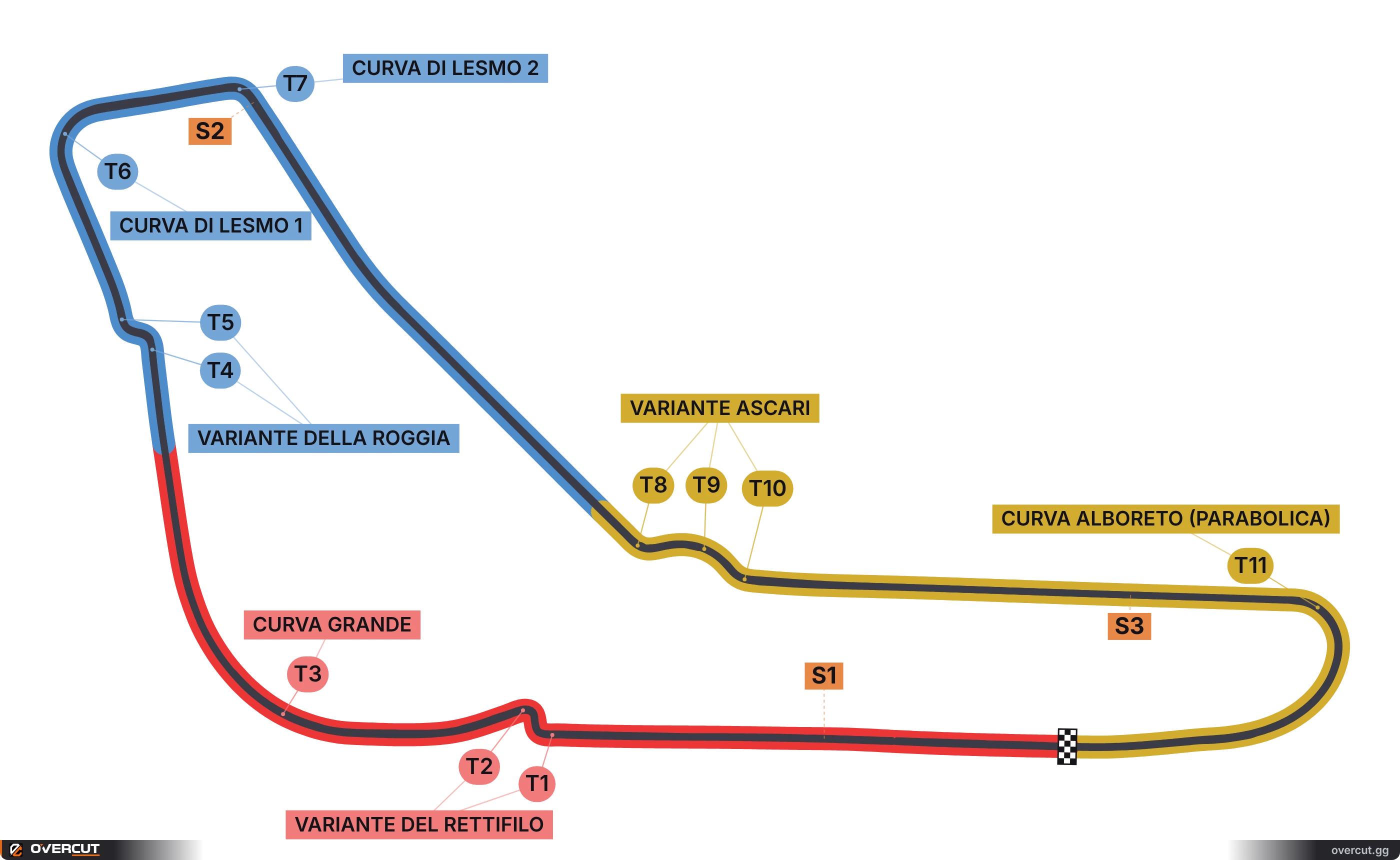
Elevation profile
Monza runs 5.793 km over 11 corners, 4 left and 7 right, driven clockwise.
The layout Overcut measured is 5.781 km, and every distance quoted here for corners, sectors and straights is taken on it.
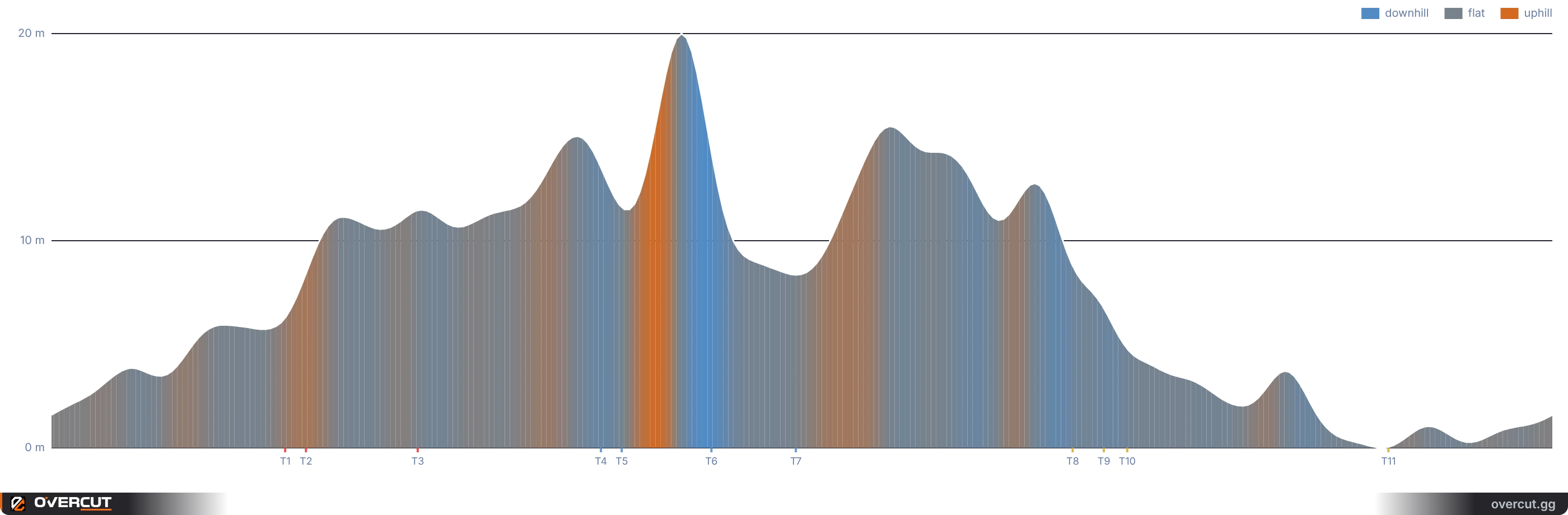
It rises and falls 20.4 m. The steepest climb reaches 6.5% and the steepest drop 7.3%.
The longest straight is 1,196 m, between Curva Alboreto (Parabolica) and Variante del Rettifilo.
The track is 8.5 to 13.8 m wide, and its longest corner is Curva Alboreto (Parabolica), 380 m of tarmac from entry to exit.
The sector lines fall at 1,949 m and 3,846 m, not at thirds of the lap.
The story
Monza was ready in 1922, in 110 days, and Formula1.com calls it the world's third purpose-built race track, after Brooklands and Indianapolis; the circuit itself also calls it the third in the world. Known as the Temple of Speed, it rebuilt its banked ring in 1955, the year the Parabolica also appeared. After the tragedy of 1961, Formula 1 stopped using the banking. In 1972, two chicanes were built to hold down averages approaching 250 km/h. Today the lap is 5.793 km.
- 1922
Opened in the rain, with the Italian Grand Prix the same month
The Automobile Club of Milan decides to build the circuit in January 1922, and it opens officially on 3 September, on a rainy day, with a race for small cars won by Pietro Bordino in a Fiat 501. The Italian Grand Prix is held there that same month.
- 1955
The Parabolica and the rebuilt banking
Works in 1955 restore a 10 km complex: a road circuit of 5,750 m, with a single curve of growing radius at the end, called the Parabolica, plus a 4,250 m high-speed ring on concrete with two banked turns. The Italian Grand Prix uses this layout in 1955, 1956, 1960 and 1961.
- 1961
Formula 1's last race on the banking
A fatal accident in the 1961 Italian Grand Prix, which killed Ferrari driver Wolfgang von Trips and spectators, ends the use of the banked ring by Grand Prix single-seaters.
- 1972
Two chicanes against averages near 250 km/h
With race averages close to 250 km/h, two chicanes are added in 1972, agreed with the drivers' association: one before the Curva Grande and one before the Ascari curve. The lap measures 5,775 m, and the single-seaters' lap speed drops to just under 216 km/h.
- 2021
The Parabolica is renamed Curva Alboreto
On 11 September 2021, during the Italian Grand Prix weekend, the Parabolica is renamed Curva Alboreto after Michele Alboreto, the former Ferrari driver who died in 2001 testing at the Lausitzring.
- 2026
Antonelli wins from 19th, the first Italian winner since 1966
On 6 September 2026 Kimi Antonelli, who started 19th after an engine penalty, wins the Italian Grand Prix 3.857 s ahead of Mercedes teammate George Russell, with Max Verstappen third, according to the FIA. Formula1.com says it is the first win by an Italian driver at the race since Ludovico Scarfiotti in 1966. On lap 2 Charles Leclerc crashes heavily exiting the Curva Alboreto, the corner renamed in 2021, and the red flag comes out.
Sources: Autodromo Nazionale Monza, history · Autodromo Nazionale Monza, the circuit · Formula1.com, Italian Grand Prix circuit · Formula1.com, Parabolica renamed after Alboreto · FIA, 2026 Italian GP report · Formula1.com, 2026 Italian GP race report · Formula1.com, Antonelli on his Italian GP win from P19 · Formula1.com, 2026 race results
Corner by corner
Entry, apex and exit are measured on the 5.781 km layout.| Corner | Name | Direction | Entry | Apex | Exit | Sector |
|---|---|---|---|---|---|---|
| T1 | Variante del Rettifilo | right | 879 m | 899 m | 939 m | S1 |
| T2 | Variante del Rettifilo | left | 962 m | 979 m | 997 m | S1 |
| T3 | Curva Grande | right | 1,299 m | 1,409 m | 1,504 m | S1 |
| T4 | Variante della Roggia | left | 2,089 m | 2,114 m | 2,154 m | S2 |
| T5 | Variante della Roggia | right | 2,159 m | 2,194 m | 2,214 m | S2 |
| T6 | Curva di Lesmo 1 | right | 2,464 m | 2,539 m | 2,629 m | S2 |
| T7 | Curva di Lesmo 2 | right | 2,842 m | 2,864 m | 2,889 m | S2 |
| T8 | Variante Ascari | left | 3,899 m | 3,929 m | 3,974 m | S3 |
| T9 | Variante Ascari | right | 3,989 m | 4,049 m | 4,089 m | S3 |
| T10 | Variante Ascari | left | 4,104 m | 4,139 m | 4,174 m | S3 |
| T11 | Curva Alboreto (Parabolica) | right | 5,084 m | 5,144 m | 5,464 m | S3 |
Which simulators ship this circuit



 AC


More race tracks
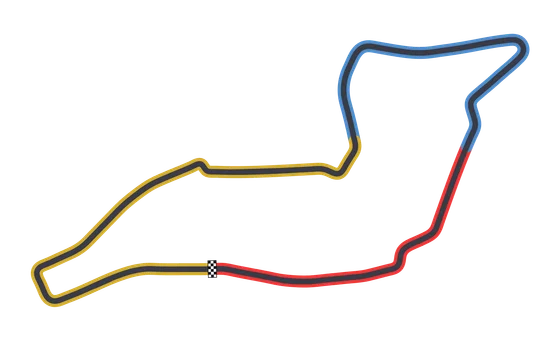 ImolaImola, Emilia-Romagna, Italy4.909 km · 19 corners · 34.7 m of relief
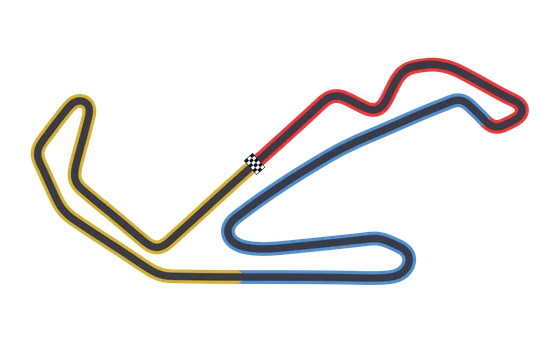 MisanoMisano Adriatico, Emilia-Romagna, Italy4.217 km measured · 16 corners · 8.1 m of relief
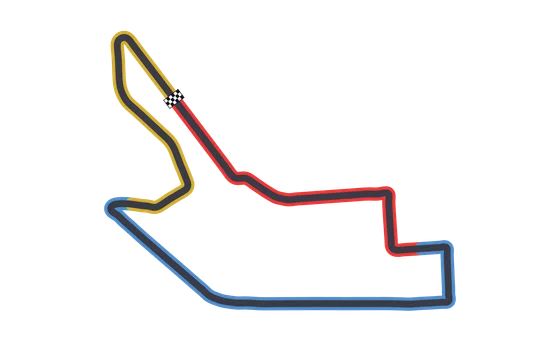 AdelaideAdelaide, South Australia, Australia3.219 km · 14 corners · 15.2 m of relief
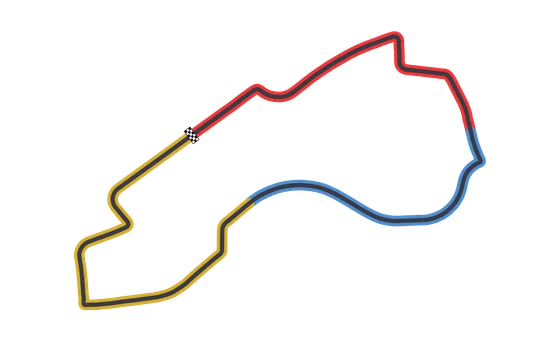 Albert ParkMelbourne, Victoria, Australia5.278 km · 14 corners · 6.4 m of relief
Race Monza with Overcut open on a tablet: your live telemetry on any screen. See how Overcut works →