
Elevation profile
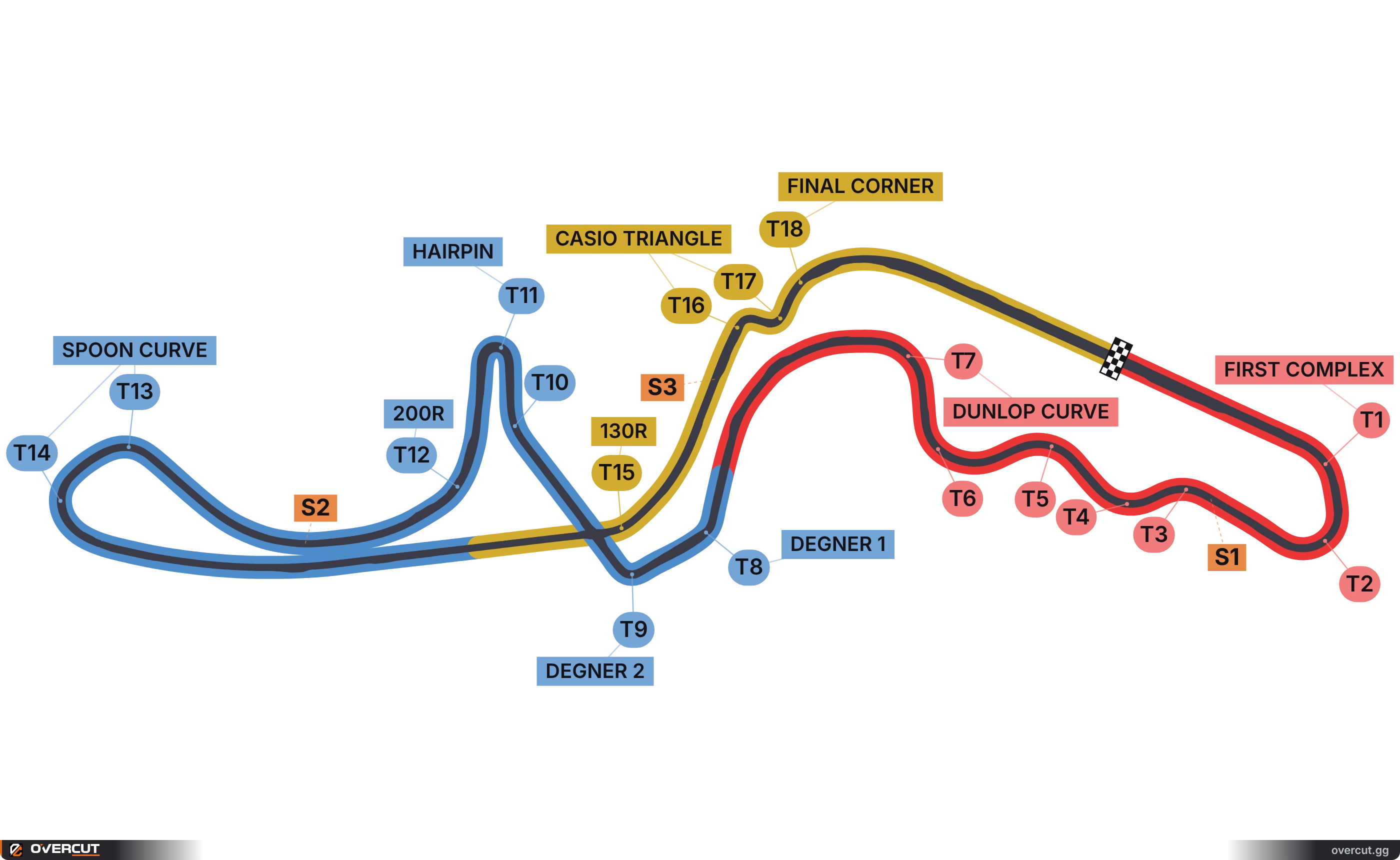
Suzuka runs 5.807 km over 18 corners, 8 left and 10 right.
The layout Overcut measured is 5.802 km, and every distance quoted here for corners, sectors and straights is taken on it.
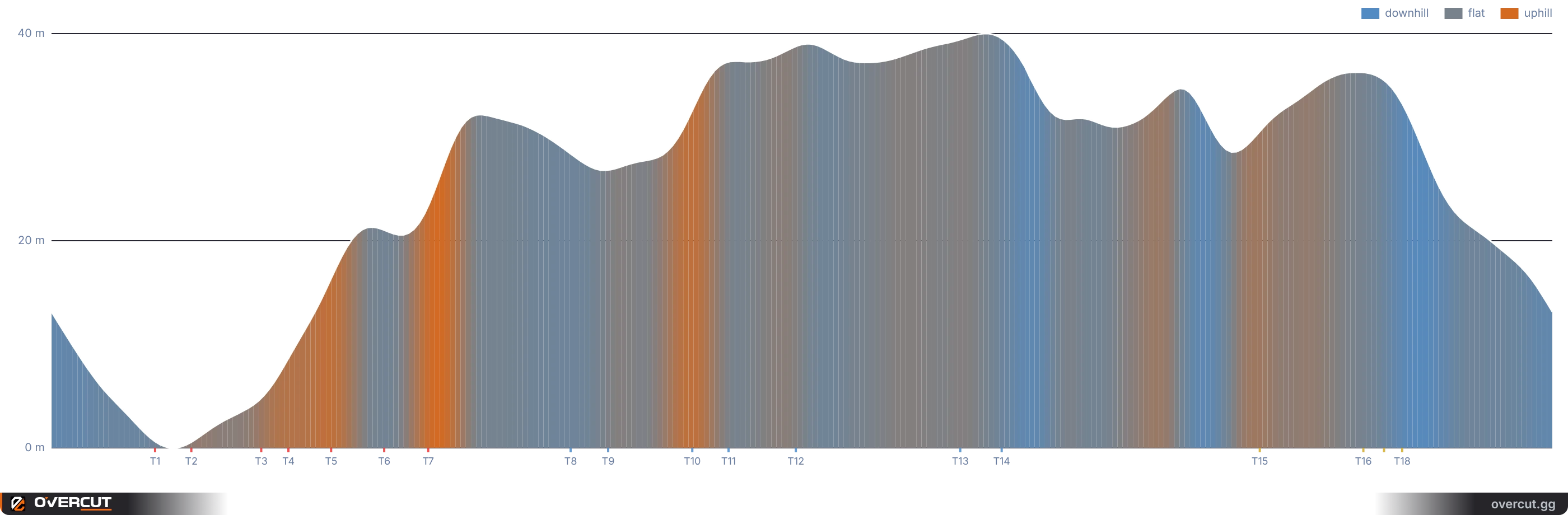
It rises and falls 40.2 m, 2.0x the relief of Monza. The steepest climb reaches 6.8% and the steepest drop 6.1%.
The longest straight is 900 m, between Spoon Curve and 130R.
The track is 9.1 to 18.9 m wide, and its longest corner is Final Corner, 225 m of tarmac from entry to exit.
The sector lines fall at 1,902 m and 4,421 m, not at thirds of the lap.
The story
Suzuka was built by Honda in 1962 as its own test track, and Honda describes it as Japan's first full-scale, international-level racing course. Its figure-eight layout, with a crossover, is the work of the Dutchman John Hugenholtz, according to Formula1.com. Formula 1 only arrived in 1987, and from 1987 to 1991 the drivers' championship was settled there five years running. The lap is 5.807 km.
- 1987
Formula 1 arrives, and Berger wins for Ferrari
The first Formula 1 race at Suzuka is held on 1 November 1987. Gerhard Berger wins for Ferrari, ahead of Ayrton Senna's Lotus. Formula1.com recalls that Nigel Mansell crashed in qualifying and could not race, which handed that year's championship to his rival Nelson Piquet.
- 1988
Senna stalls on the grid, climbs from 14th and wins the title
Ayrton Senna arrives knowing a win would give him his first world title. He takes pole, then stalls at the start. Formula1.com says the grid sloped downhill, so he could bump-start the McLaren while the field went past. By lap 14 he was third, up from 14th, and on lap 28 he passed his teammate Alain Prost for the lead. He won the race and the championship.
- 1989
Prost and Senna lock wheels at the chicane, and Senna is disqualified
On lap 46 on 22 October 1989, Senna goes for the inside at the chicane while his McLaren teammate and title rival Alain Prost is ahead. Formula1.com says Prost turns in and the cars lock wheels. Senna restarts with the marshals' help, takes a new front wing, passes Alessandro Nannini for the lead, and is then disqualified for cutting the chicane. The official result gives the win to Nannini, and Prost is champion.
- 1990
Senna and Prost touch at the first corner, and Senna is champion
For the third year running the two arrive at Suzuka fighting for the title, now with Prost at Ferrari. Prost beats Senna to the first corner, and Senna says he had promised himself to go for it there whatever the result. They touch and both are out on the spot. Senna is champion, in circumstances Formula1.com calls no less controversial than the year before.
- 2000
Schumacher ends Ferrari's 21-year wait
On 8 October 2000 Michael Schumacher beats Mika Häkkinen by 1.837 s and becomes Ferrari's first drivers' champion since Jody Scheckter in 1979, according to Formula1.com. Two years earlier Häkkinen had clinched his title at Suzuka, which the same site counted as the seventh championship decided there in 12 years.
- 2026
Antonelli wins and becomes the youngest championship leader
On 29 March 2026 Kimi Antonelli wins the Japanese Grand Prix, round 3 of the season, 13.722 s ahead of Oscar Piastri, with Charles Leclerc third. Piastri takes the lead into Turn 1 from the Mercedes pair, but a heavy crash for Ollie Bearman brings out the Safety Car on lap 22, which lets Antonelli, yet to pit, rejoin in first. Formula1.com says the win makes him the youngest driver in history to lead the championship.
Sources: Honda, Suzuka Circuit introduction · Formula1.com, Japanese Grand Prix circuit · Formula1.com, moments in time: the Japanese Grand Prix · Formula1.com, 1987 Japanese Grand Prix result · Formula1.com, 1989 Japanese Grand Prix result · Formula1.com, 2000 Japanese Grand Prix result · Motor Sport Magazine, 1991 Japanese Grand Prix report (December 1991) · Formula1.com, 2026 Japanese GP race report · Formula1.com, 2026 race results · Motor Sport Magazine, Mansell is finally crowned (1992 Hungarian GP)
Corner by corner
Entry, apex and exit are measured on the 5.802 km layout.| Corner | Name | Direction | Entry | Apex | Exit | Sector |
|---|---|---|---|---|---|---|
| T1 | First Complex | right | 366 m | 398 m | 468 m | S1 |
| T2 | First Complex | right | 468 m | 538 m | 588 m | S1 |
| T3 | no official name | left | 758 m | 808 m | 853 m | S1 |
| T4 | no official name | right | 863 m | 913 m | 983 m | S1 |
| T5 | no official name | left | 1,018 m | 1,078 m | 1,143 m | S1 |
| T6 | no official name | right | 1,168 m | 1,283 m | 1,348 m | S1 |
| T7 | Dunlop Curve | left | 1,416 m | 1,453 m | 1,558 m | S1 |
| T8 | Degner 1 | right | 1,953 m | 2,003 m | 2,053 m | S2 |
| T9 | Degner 2 | right | 2,108 m | 2,148 m | 2,198 m | S2 |
| T10 | no official name | right | 2,428 m | 2,473 m | 2,518 m | S2 |
| T11 | Hairpin | left | 2,548 m | 2,613 m | 2,683 m | S2 |
| T12 | 200R | right | 2,778 m | 2,873 m | 2,938 m | S2 |
| T13 | Spoon Curve | left | 3,478 m | 3,508 m | 3,588 m | S2 |
| T14 | Spoon Curve | left | 3,588 m | 3,668 m | 3,731 m | S2 |
| T15 | 130R | left | 4,631 m | 4,671 m | 4,726 m | S3 |
| T16 | Casio Triangle | right | 5,036 m | 5,071 m | 5,116 m | S3 |
| T17 | Casio Triangle | left | 5,116 m | 5,151 m | 5,181 m | S3 |
| T18 | Final Corner | right | 5,191 m | 5,221 m | 5,416 m | S3 |
Which simulators ship this circuit



More race tracks
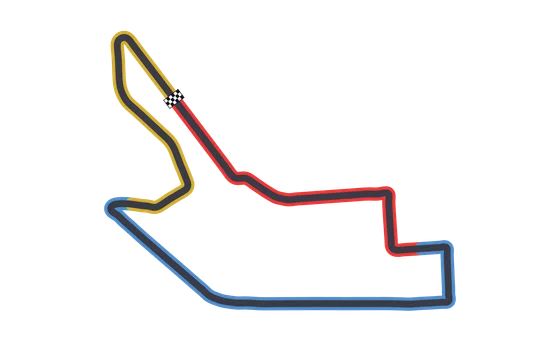 AdelaideAdelaide, South Australia, Australia3.219 km · 14 corners · 15.2 m of relief
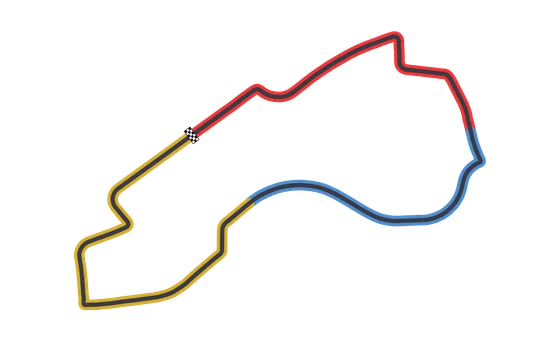 Albert ParkMelbourne, Victoria, Australia5.278 km · 14 corners · 6.4 m of relief
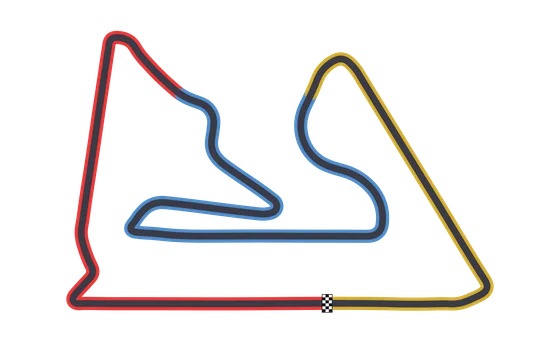 BahrainSakhir, Southern Governorate, Bahrain5.412 km · 15 corners · 15.9 m of relief
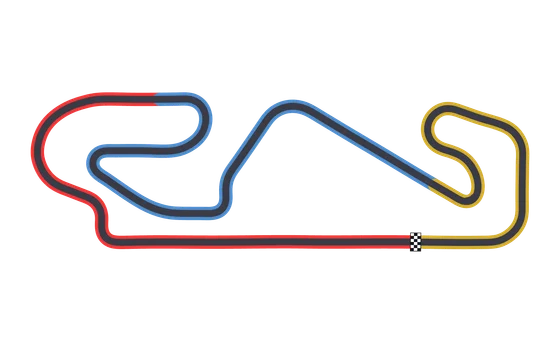 BarcelonaMontmeló, Catalonia, Spain4.657 km · 14 corners · 28 m of relief
Race Suzuka with Overcut open on a tablet: your live telemetry on any screen. See how Overcut works →