
Zandvoort
Zandvoort, North Holland, Netherlands · 4.259 km · 14 corners
Official site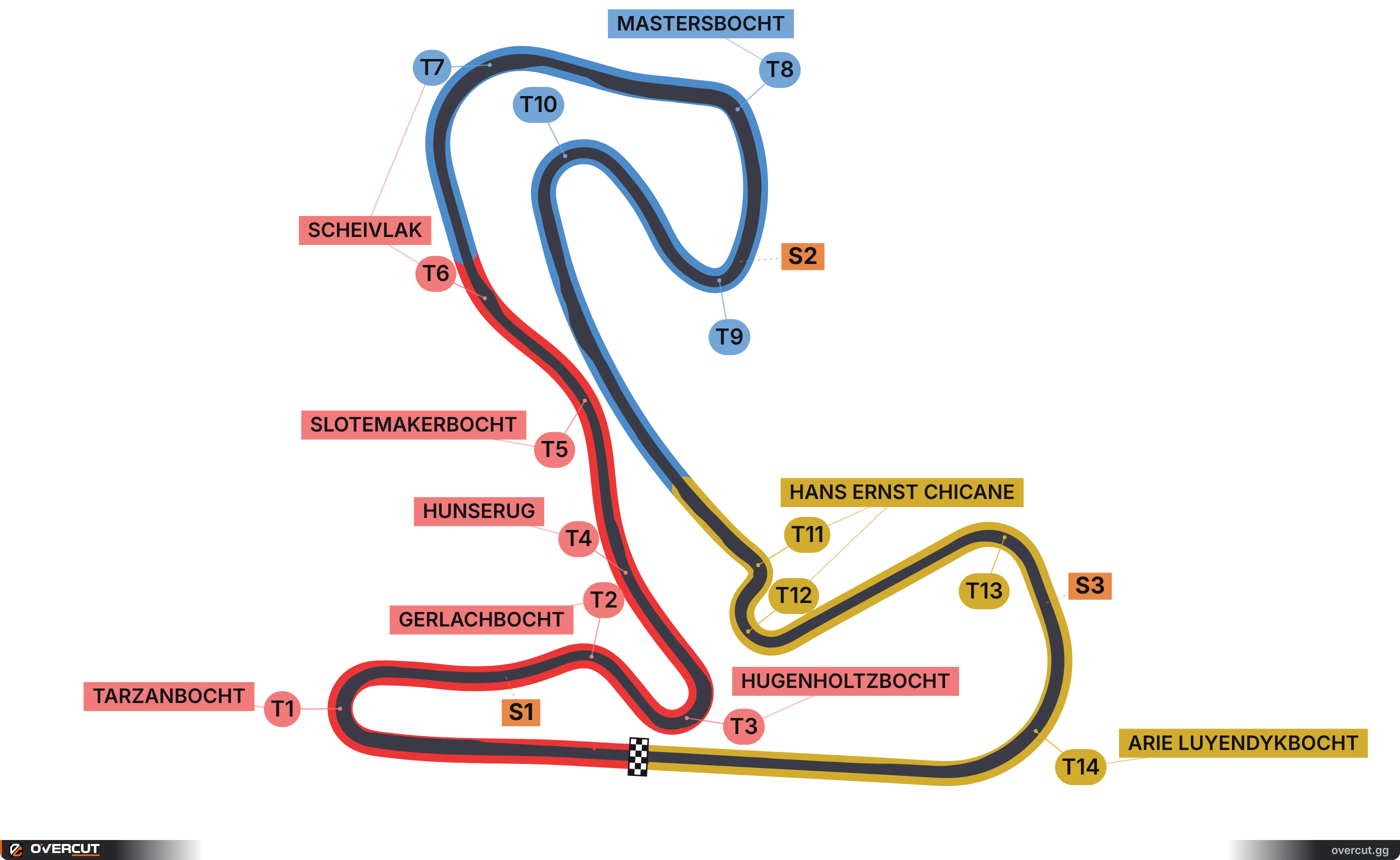
Elevation profile
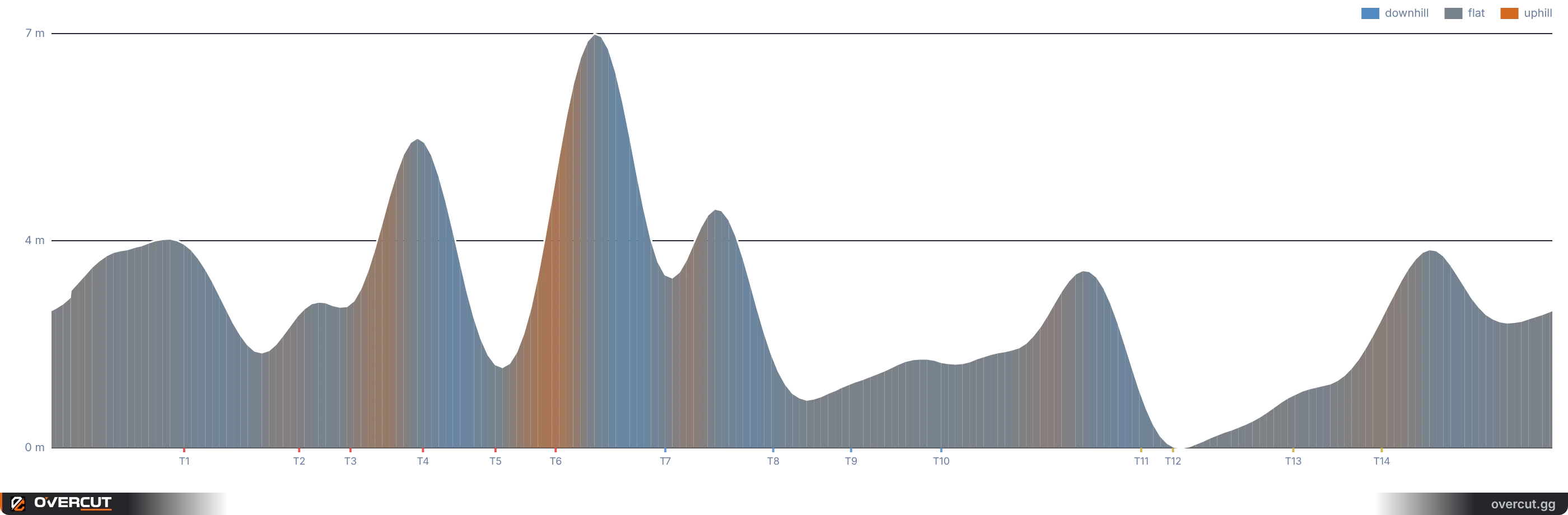
Zandvoort runs 4.259 km over 14 corners, 4 left and 10 right, driven clockwise.
The layout Overcut measured is 4.255 km, and every distance quoted here for corners, sectors and straights is taken on it.
It rises and falls 7.4 m, 0.4x the relief of Monza. The steepest climb reaches 3.6% and the steepest drop 3.2%.
The longest straight is 755 m, between Arie Luyendykbocht and Tarzanbocht.
The track is 2.6 to 17.9 m wide, and its longest corner is T10, 215 m of tarmac from entry to exit.
The sector lines fall at 1,488 m and 2,965 m, not at thirds of the lap.
The story
Zandvoort was born in the North Sea dunes from a project begun in 1939 and delayed by the war; the first layout used some of the roads opened during the German occupation, and the circuit was completed in 1948. Formula 1 raced there between 1952 and 1985, stayed away for 36 years, came back in 2021 with two banked corners and said goodbye in 2026, after the promoter decided not to continue. The 2026 lap measures 4.259 km.
- 1948
A circuit in the dunes, finished in 1948 after the war
The circuit's own history says a street race on 3 June 1939 started the plan, that the war delayed construction, that mayor Van Alphen kept working on it in secret after the Germans removed him from office, and that the track was finally completed in 1948, opening with a race on 7 August won by Prince Bira. Formula1.com adds that the first track used some of the roads built by a Nazi group. Who drew the layout is disputed: David Tremayne writes on Formula1.com that the credit went to John Hugenholtz, track manager from 1949 to 1974 and later the designer of Suzuka, while current thinking points to the 1927 Le Mans winner Sammy Davis, track advisor in July 1946.
- 1952
Zandvoort joins the World Championship with a Ferrari 1-2-3
In 1952 the Dutch race counts for the World Championship for the first time, in a season of only eight races, according to the circuit. On 17 August Alberto Ascari dominates and leads home a Ferrari 1-2-3, says Formula1.com. The circuit names Fangio, Moss and Ascari among the winners of the 1950s, and Graham Hill, Jackie Stewart and Jack Brabham among those of the 1960s.
- 1970 to 1974
A year away, and the return is marked by Williamson's death
In 1970 Piers Courage was killed at the back of the circuit. The 1972 race was not held because, the circuit says, the track failed its safety inspection. The Grand Prix came back in 1973 with a new corner, the Panoramabocht, and Roger Williamson crashed; his car caught fire, and the circuit's own history says the accident became fatal for lack of extinguishers. After more safety work the race returned in 1974, won by Niki Lauda.
- 1985 to 1999
Lauda wins in 1985, and Formula 1 leaves for 36 years
Niki Lauda won the Dutch Grand Prix on 25 August 1985, and Formula 1 did not return to Zandvoort for 36 years. Motor Sport writes that the circuit struggled financially after losing the race, went bankrupt in 1988 and was taken over by the town council. Dutch noise laws also forced changes: a shorter circuit, separated from the town by a man-made dune, opened in 1989, and ten years later it was extended back to Grand Prix length.
- 2021
Formula 1 returns after 36 years, with banked corners
The return was announced on 14 May 2019, and the 2020 race was cancelled because of the Covid-19 pandemic, so the first Formula 1 race at Zandvoort in 36 years was held on 5 September 2021. For the comeback the Hugenholtz and Arie Luyendyk corners were banked; Formula1.com says the Hugenholtzbocht was widened and banked into a parabolic corner so that cars could run through it side by side. Max Verstappen won the first three races after the return, in 2021, 2022 and 2023; Lando Norris won in 2024 and Oscar Piastri in 2025.
- 2026
The last Dutch Grand Prix: Verstappen crashes, Norris wins
In December 2024 the organisers agreed to only one more year and chose to stop after 2026; Robert van Overdijk, director of the Dutch Grand Prix, said the privately owned business had to weigh the event against other risks and responsibilities. On 23 August 2026, Zandvoort's final Formula 1 weekend, Norris started from pole, Verstappen lost the rear of his Red Bull and hit the wall after one lap, and the race was red-flagged. Kimi Antonelli took the lead at the restart, Norris took it back in the final third and won by 11.536 s.
Sources: Circuit Zandvoort, history · Formula1.com, David Tremayne on John Hugenholtz (October 2022) · Formula1.com, Dutch Grand Prix 2025 circuit · Motor Sport database, Zandvoort · Formula1.com, 1952 season results · Formula1.com, 1985 season results · Formula1.com, 2021 season results · Formula1.com, 2022 season results · Formula1.com, 2023 season results · Formula1.com, 2024 season results · Formula1.com, 2025 season results · Motorsport.com, F1 to host final Dutch Grand Prix in 2026 (December 2024) · Formula1.com, 2026 Dutch Grand Prix race report · FIA, 2026 Dutch Grand Prix circuit map
Corner by corner
Entry, apex and exit are measured on the 4.255 km layout.| Corner | Name | Direction | Entry | Apex | Exit | Sector |
|---|---|---|---|---|---|---|
| T1 | Tarzanbocht | right | 285 m | 375 m | 475 m | S1 |
| T2 | Gerlachbocht | right | 655 m | 700 m | 755 m | S1 |
| T3 | Hugenholtzbocht | left | 770 m | 845 m | 930 m | S1 |
| T4 | Hunserug | right | 1,015 m | 1,050 m | 1,115 m | S1 |
| T5 | Slotemakerbocht | left | 1,195 m | 1,255 m | 1,325 m | S1 |
| T6 | Scheivlak | right | 1,380 m | 1,425 m | 1,480 m | S1 |
| T7 | Scheivlak | right | 1,657 m | 1,735 m | 1,777 m | S2 |
| T8 | Mastersbocht | right | 2,012 m | 2,040 m | 2,150 m | S2 |
| T9 | no official name | right | 2,150 m | 2,260 m | 2,307 m | S2 |
| T10 | no official name | left | 2,390 m | 2,515 m | 2,605 m | S2 |
| T11 | Hans Ernst Chicane | right | 3,055 m | 3,080 m | 3,125 m | S3 |
| T12 | Hans Ernst Chicane | left | 3,130 m | 3,170 m | 3,250 m | S3 |
| T13 | no official name | right | 3,445 m | 3,510 m | 3,580 m | S3 |
| T14 | Arie Luyendykbocht | right | 3,692 m | 3,760 m | 3,785 m | S3 |
Which simulators ship this circuit


 AC
More race tracks
 AdelaideAdelaide, South Australia, Australia3.219 km · 14 corners · 15.2 m of relief
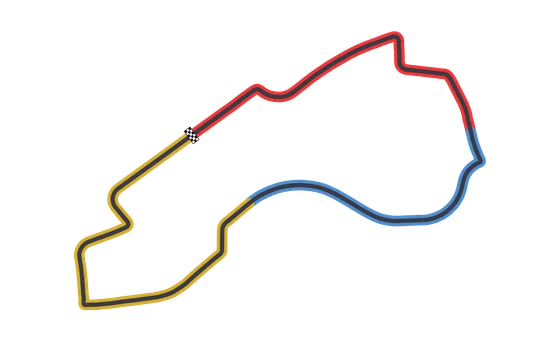 Albert ParkMelbourne, Victoria, Australia5.278 km · 14 corners · 6.4 m of relief
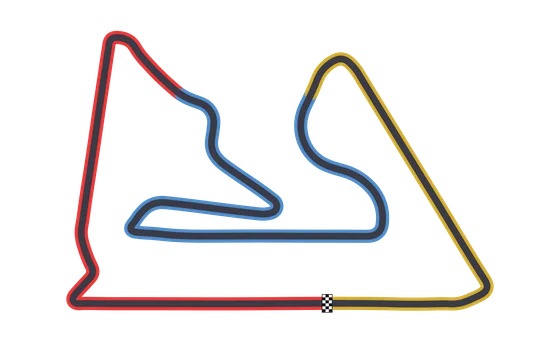 BahrainSakhir, Southern Governorate, Bahrain5.412 km · 15 corners · 15.9 m of relief
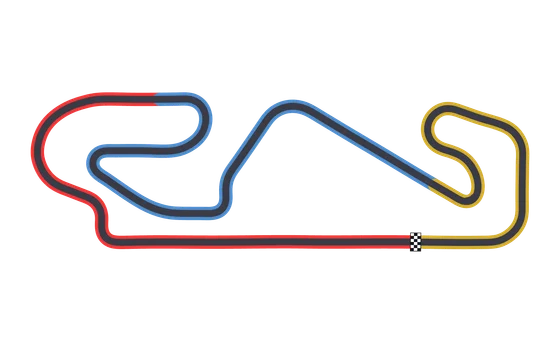 BarcelonaMontmeló, Catalonia, Spain4.657 km · 14 corners · 28 m of relief
Race Zandvoort with Overcut open on a tablet: your live telemetry on any screen. See how Overcut works →